Short answer: A chauffeur business succeeds or fails on the phone, not the car. Publish fixed prices for your ten busiest routes, confirm and spell back every address, send a written confirmation within minutes, and make sure someone answers every call, including while you are driving. Those four habits protect more revenue than any vehicle upgrade.
Most guides for chauffeur operators talk about vehicles, licensing and insurance. Those matter, but they are solved problems: you buy the car, you get the accreditation, you renew the policy. The part nobody writes about honestly is the phone, which is where the money actually leaks. This guide is written from inside a working transfer company on the Gold Coast, and it covers the operational habits that decide whether a caller becomes a fare or becomes someone else's fare.
What does a chauffeur business actually sell?
A chauffeur business sells certainty, not transport. The customer is buying the guarantee that the right car arrives at the right door at the right minute, driven by someone who will not let them miss a flight or a meeting. Every operational decision should protect that promise.
This distinction is not philosophical, it is practical. If you are selling transport, you compete on price with every rideshare driver in the city. If you are selling certainty, you compete on reliability, and reliability is something you can charge properly for.
It also tells you where to spend your effort. A leather seat does not create certainty. A confirmed pickup address does. A written confirmation does. A phone that always gets answered does.
Who this guide is for
Solo owner-drivers, small fleets of two to ten cars, and airport-transfer specialists who take bookings by phone. If your customers ring you, describe a trip, and expect a price, this was written for you. If you take 100% of your work through a broker app, some sections will not apply.
How much does it cost to start a chauffeur business?
Beyond the vehicle, expect commercial passenger vehicle accreditation, commercial insurance, and ongoing costs for fuel, servicing and cleaning. The overlooked cost is administrative: the hours spent answering calls, quoting, confirming and rescheduling, which quietly consume the time you could be driving.
Licensing requirements differ by state and country. In Australia, commercial passenger vehicle rules are set at state level, so check your own regulator rather than trusting a generic figure from a blog. The Queensland Department of Transport and Main Roads and the Victorian government's commercial passenger vehicle guidance are the primary sources for those two states.
The cost most new operators underestimate is not capital, it is attention. Every quote call, every reschedule and every "are you still coming?" text is unpaid labour. It is invisible on a spreadsheet and enormous in practice.
How to price chauffeur work in 2026
Use three models together: fixed prices for your busiest routes, hourly hire for events and tours, and distance-plus-time for everything else. Fixed pricing wins the phone call because the caller gets a number in seconds instead of a promise to call back.
Here is how the three compare in practice.
| Model | Best for | Why it wins | Where it hurts |
|---|---|---|---|
| Fixed route | Airport transfers | Instant quote on the phone, no negotiation, easy to advertise | Heavy traffic eats the margin on a bad run |
| Hourly hire | Events, weddings, tours | Protects your whole day, simple to explain | Underquoting a long day is expensive and hard to undo |
| Distance + time | Ad-hoc and one-off trips | Fair on every single job | Slow to quote verbally, which loses impatient callers |
Whatever you choose, write the rate card down and keep it somewhere anyone answering your phone can read it in under five seconds. A price that lives only in your head is a price that changes by accident.
The booking process, step by step
A reliable booking flow has five steps: answer in the business name, capture the trip details, confirm and spell back the address, quote from the rate card or take details for a callback, then send a written confirmation and add the job to the run sheet.
- Answer in the business name. "Good morning, Meridian Transfers" tells the caller they reached a company, not a mobile phone.
- Capture the trip. Pickup, drop-off, date, time, passenger count, luggage, and any flight number.
- Confirm and spell back the address. This single habit prevents the most expensive failure in the industry.
- Quote or commit to a callback with a time. "I will call you back within the hour" is a promise; "I will get back to you" is not.
- Send the written confirmation. Then put the job on a run sheet you can see, not in your memory.
Why the address matters more than anything else
A wrong suburb is a missed pickup, a refund, and often a one-star review. Confirming and spelling back the address on every call is the cheapest quality control in the business, and it takes about eight seconds.
Australia makes this worse than most countries because suburb names repeat across states and many are phonetically ambiguous. Indooroopilly, Coorparoo and Yeronga are obvious to a Brisbane local and a coin toss to anyone else. If you take interstate or international bookings, assume nothing.
Why do chauffeur operators lose so many fares to missed calls?
Because a customer who reaches voicemail simply dials the next company. Transfer work is urgent and substitutable: the caller needs a car at a specific time, and any competent operator will do. The business that answers first usually wins the job.
This is the structural problem of the industry. Your most billable hours are exactly the hours you cannot safely answer the phone, because you are driving. Every hour behind the wheel is an hour your competitors can win work you never heard about.
The old workarounds all have costs. A call centre is expensive and does not know your rate card. A partner answering the phone does not scale. Voicemail loses the job outright, because most callers do not leave one.
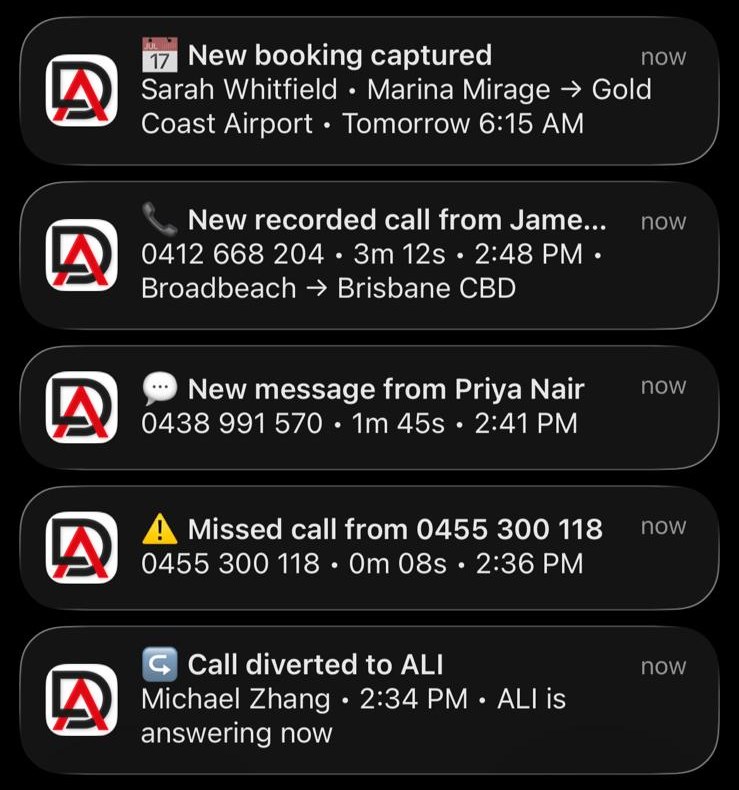
Watch: 🚗 The missed calls quietly costing chauffeur operators thousands
This short walkthrough shows the missed-call problem in a real operator's day, and what the call log looks like when every call gets answered.
How do I take bookings while I am driving?
Give customers a DeskAli number that answers on your behalf, captures the trip, and sends it to you in writing. You never touch the phone while driving, and no booking is lost to voicemail. The key requirement is that whatever answers must know your rate card and confirm addresses properly.
This is the problem DeskAli was built for, and it was built inside a working transfer company rather than in the abstract. It answers in your business name, captures the pickup, drop-off and time, spells the address back to the caller, and sends you the booking as a notification before you have pulled over. You can see the plans or start a free trial and hear it answer your own number.
If you also run drivers rather than driving every job yourself, the dispatch side is a separate problem worth solving properly. ChauffeurFlow, from the same team behind DeskAli, handles the operator-and-driver side of that workflow.
Common mistakes that quietly cost operators money
- No fixed prices. Every airport call becomes a negotiation you may lose.
- Letting the phone ring out during a job. The most common and most expensive mistake in the industry.
- Not spelling back the address. One missed pickup wipes out the profit on several successful ones.
- No written confirmation. No-shows climb, and you have no record of what was agreed.
- Keeping the run sheet in your head. It works until the day you take two bookings for the same hour.
- Competing on price with rideshare. You are selling certainty. Sell it.
Best practices that separate professionals from hobbyists
Professionals confirm in writing, arrive early rather than on time, keep a rate card anyone can read, and never let a call go unanswered. None of these require money, only systems.
Arrive early is worth expanding. The industry standard for an airport pickup should be at the door before the stated time, not at it. The cost is a few minutes of waiting; the benefit is that you never make a customer anxious, and anxious customers do not rebook.
"The car is the easy part. Every operator I know who grew did it by fixing the phone first." — Julyo Lott, founder of DeskAli and operator of a Gold Coast transfer company
Frequently asked questions
What should I charge for an airport transfer?
Set a fixed price per route based on distance, time of day and vehicle class, then publish it. Fixed prices win the call because the caller gets an answer in seconds rather than a callback.
Do I need commercial insurance for a chauffeur business?
Yes. Standard private motor insurance will not cover carrying passengers for hire or reward. Speak to a broker who understands commercial passenger vehicles, and confirm your state's accreditation requirements with the regulator directly.
How do I reduce no-shows?
Send a written confirmation immediately after booking, and a reminder the day before with the pickup time and address. Most no-shows are misunderstandings about time or place, not deliberate.
Should I take bookings through an app or by phone?
Both, but do not let the app replace the phone. Corporate and older customers still call, and phone bookings usually carry higher value than app-hailed trips.
What is the busiest time for airport transfers?
Early morning departures and late evening arrivals, which are exactly the hours a solo operator is least able to answer the phone. Cover those hours first.
How many cars do I need before hiring drivers?
Hire when you are turning away work regularly, not when you feel busy. Track declined bookings for a month; if the number would cover a driver's wage, it is time.
Can an AI receptionist really take a booking correctly?
It can, provided it confirms and spells back addresses and works from your actual rate card. The failure mode to test for is a wrong suburb, so test that specifically before trusting it with live calls.
How do I compete with rideshare on price?
You do not. Compete on certainty: a fixed price agreed in advance, a car that is definitely coming, and a driver who tracks the flight. Customers who need to be somewhere on time pay for that.
Summary and key takeaways
The chauffeur businesses that grow are the ones that answer every call, price clearly and confirm every address. The vehicle is the easy part; the phone is the business.
- You are selling certainty, not transport. Price and operate accordingly.
- Publish fixed prices for your ten busiest routes.
- Confirm and spell back every address, every time.
- Send a written confirmation within minutes of booking.
- Never let the phone ring out, especially during your busiest driving hours.
Your action checklist
- Write your rate card for your ten busiest routes today.
- Add an address confirmation step to every booking call.
- Set up an automatic written confirmation.
- Decide who or what answers the phone while you are driving.
- Track declined bookings for one month, then review.
Related reading: all DeskAli guides, the industries we serve, support and setup help, and our terms. You can also compare plans, start a free trial, or read how we handle call data. For the wider regulatory picture see the ACCC's guidance for small business and business.gov.au.